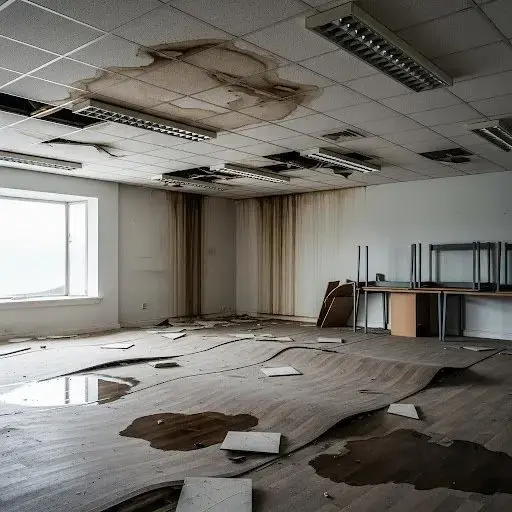
Colton calls itself Hub City, and its mix of hospital, retail, school and logistics employers means business water losses come in many shapes. A burst supply pipe in a small shop and a roof drain failure over a warehouse need different handling, but the first day follows the same path. This post lays out that path for owners and managers.
Key takeaways
- Colton's business base ranges from a regional hospital and schools to Walmart and logistics operations, so water losses vary widely.
- The first day is about shutting off the source, protecting people and stock, and building a record.
- Phased drying splits a building into zones so unaffected areas can keep working.
- Commercial claims depend on the lease, the insurance policy and clear documentation.
- A moisture map and daily readings show when each zone is dry.
Why Colton business losses vary so much
Arrowhead Regional Medical Center is Colton's largest employer, and the city's other top employers include Walmart and logistics operations, along with the school district and the County of San Bernardino. Valley Boulevard, where Colton High School sits, is one of the corridors that carries business traffic.
A medical office, a retail shop, a warehouse and a classroom wing all handle water differently. Flooring, ceilings, stored goods and equipment change what has to be removed, saved or tested.
Colton also has a rail history, including Colton Crossing, the junction where the BNSF and Union Pacific routes cross. Storage and distribution space in a city like this has wide concrete floors, where water spreads over a large area.
- Retail and office space has carpet, ceiling tile and drywall that wick water
- Warehouse space has concrete floors and stored goods that sit directly on them
- Medical and school buildings have strict hygiene and access needs
- Food service areas have floor drains, coolers and grease traps
A first day plan for owners and managers
The steps are the same whether the loss is a few square feet of ceiling or a whole floor.
A one page emergency card with the shutoff location, the insurer's contact details kept in the owner's own files and the restoration contact helps the next person on shift.
Staff training matters as much as the plan. A new employee who does not know where the shutoff is can lose the first, most valuable stretch of a loss.
- Stop the source: close the nearest shutoff or the building main.
- Cut power to wet areas and keep staff and customers out of standing water.
- Photograph the source, the water level and the damaged stock and fixtures.
- Move inventory and records off the floor to dry shelves or counters.
- Call the landlord, property manager and insurer, and note the time of each call.
- Contact a restoration crew so extraction and a moisture map can start.
Safety before stock
A wet floor with electrical equipment nearby is a hazard. Staff should leave the area until power is off and the source is controlled.
Common sources of commercial water loss
Commercial buildings share many of the failures of a home, only larger and often hidden above ceilings or inside walls.
Many of these failures can be spotted early with a quick walk through after closing or on a Monday morning, when stains and puddles from the weekend are most visible.
A pressure or leak test by a plumber confirms the source before the repair is planned, and the results belong in the claim file.
- Supply pipe splits and failed fittings
- Roof drain overflows and flat roof leaks
- Fire sprinkler discharge or damage
- Failed water heaters and toilet or sink supply hoses
- Drain backups from a blocked sewer connection
Why a hidden leak is expensive
A leak above a ceiling can run for days before a stain shows. By then insulation, drywall and anything stored below may be wet.
Phased drying for shops, offices and warehouses
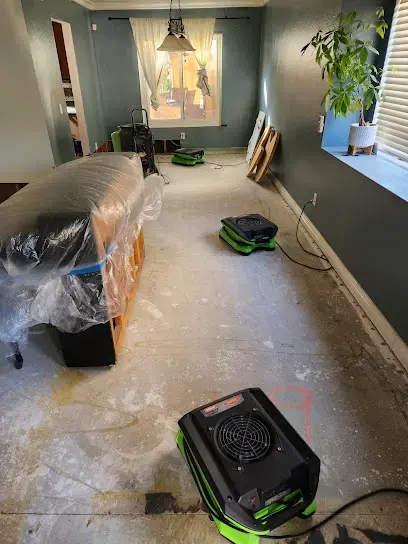
A commercial water damage job is planned in zones. The crew extracts standing water, maps moisture with meters and sets equipment in the wettest zone first.
Other zones are checked and dried in order, so a shop floor can reopen while a back office is still being treated. Daily readings show which areas have reached a dry standard.
A larger or more complex loss also needs coordination with tenants next door, because water moves through shared walls and floors. The commercial page explains how those decisions are made.
Warehouse floors are often sealed concrete, which can be extracted quickly, while the pallets and cardboard stored on top absorb water. Moving goods early shortens the drying job.
The crew also checks ceiling tile, suspended light fixtures and wall cavities, because water travels along a ceiling before it drips and the visible spot is rarely the source.
City water and the building shutoff
The City of Colton Water & Wastewater Department runs the city water system, and all of the city's water comes from deep wells. The system has 10 wells, 4 main booster pumping plants and 6 storage reservoirs.
A business owner should know where the building's main shutoff is and who can reach it when the building is closed. Keeping that information with the manager and the landlord saves time during a loss.
Terrace Water Company is a separate company with an office in Colton, so the water provider can differ depending on the address.
Terrace Water Company's own service area is not described here. A business can ask its provider to confirm which company supplies the building.
Medical, school and food service buildings
Some Colton buildings carry stricter rules than a typical shop. A clinic, a classroom or a kitchen has hygiene standards that affect how the cleanup is done and when the space can be used again.
The restoration crew can document its work for the building owner, the operator and the insurer, but any health or school authority requirements are separate and should be confirmed with that agency.
- Isolate the affected area with containment so dust and moisture do not spread
- Keep a written log of every step, including materials removed
- Confirm reopening requirements with the operator before staff return
- Treat food, ice and packaging that touched water as discarded
Tenants, landlords and records
In a leased space, the lease decides who pays for what. Tenant improvements, landlord building systems and shared walls often fall under different sections of the same document.
A clear record helps every party. It should include photos, the restoration scope, daily moisture readings and a log of lost business days.
Keeping them in one folder shortens the back and forth.
For help with structure drying after the contents are moved, the structural drying page covers readings and equipment.
Questions
Does a Colton business need to shut down during drying?
Not always. Phased drying lets unaffected zones keep working while the wet zone is treated.
What should be done with stock that got wet?
Photograph it, list it and move it off the floor. Some stock can be saved, but the insurer should see it before it is discarded.
Who should be called first?
The landlord or property manager, the insurer and a restoration crew, and a plumber if the source needs repair.
How does the crew know when the space is dry?
Moisture meters measure walls, floors and ceilings, and readings are logged each visit until they match a dry reference.
Is Colton's water supply from wells?
Yes. The city says all of its city water comes from deep wells, and the system has 10 wells.
Does the lease or the insurance policy decide who pays?
Both matter. The lease sets what the tenant and landlord each handle, and the policy decides what is covered, so both should be read early.