About Highland Water Damage Restoration
24/7 water damage restoration for Highland, CA and the East Valley of San Bernardino County, from the first extraction to a verified dry reading.
Built around how water behaves in Highland homes
Highland incorporated in 1987 and grew fast through the 1980s and 1990s, so much of the city sits on concrete slabs with copper supply pipe under the floor and air handlers up in the attic. Older homes near the Base Line corridor and Palm Avenue carry galvanized pipe and clay sewer laterals, and the newer tracts in East Highlands Ranch run long attic and wall plumbing.
That stock sets the list: slab leaks under hard water, attic AC drain overflows in the hot months, water heater failures in garages, and storm runoff off the foothills when winter storms stall over the San Bernardino Mountains.
Highland Water Damage Restoration does not perform the restoration work itself. A call reaches a restoration company that serves Highland, and that company identifies itself, scopes the job and does the work.
Find us on Google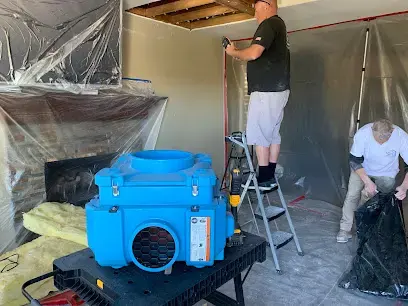
How a Highland dry-out is held to a standard
These are statements about the trade standard, not credentials. Ask the restoration contractor who responds how each one is handled on the job.
- 1
Walkthrough and moisture map
The tech who does the walkthrough maps moisture with pinless meters and thermal imaging before any equipment goes down.
- 2
Extraction
The extraction crew pulls standing water with truck-mounted extraction, so it leaves the building instead of spreading to the next room.
- 3
Air movers and LGR dehumidifiers
The drying team sets air movers to each room's evaporation load and runs LGR dehumidifiers, or desiccants for Class 4 materials.
- 4
Daily readings to the drying goal
Most crews log readings daily and pull equipment once wet material sits within 2 to 4 points of a dry reference.
What a good water damage response looks like in Highland
The first conversation should cover the source, the category of water and which rooms are wet. The crew that follows maps moisture before it sets equipment and leaves the equipment running until the readings say dry.
Rapid local response
The response team runs 24/7 dispatch and treats active water as urgent, because every hour of wicking adds drying time.
IICRC S500 drying standard
IICRC S500 is the industry drying standard. Crews map moisture first and pull equipment only when the readings say dry.
Claim-ready documentation
A moisture map, daily psychrometric logs and timestamped photos taken before any demolition, the file an adjuster reads.
East Valley water know-how
Slab leaks under hard water, attic AC drains and foothill storm runoff: the local pros know how water moves in a Highland home.
Water damage in a Highland home? Talk to someone now.
Extraction, drying and claim documentation around the clock, across Highland and the East Valley.